
In the Samson story in Judges, the would-be savior of Israel, betrayed by his people, lies captive to the Philistines, bound and blinded, as the poet John Milton writes, ‘eyeless in Gaza.’
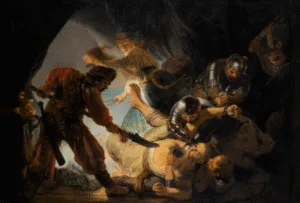
In Rembrandt’s vision – one of his four paintings of the life of the hero – Samson is pinned to the ground, immobilized beneath the armored weight of the Philistines.
To the left, a soldier’s sword, thrust between Samson’s legs, makes literal the symbolic castration, unmanned by the soldiers. Above him, Delilah stands composed, illuminated, serene, the severed locks of Samson’s strength gathered in her hand. The dark drapery behind her flares outward, and for a moment she resembles an angel. Her shears hover, but the blinding has already occurred, Samson pinned from every side, chained, shorn, penetrated.
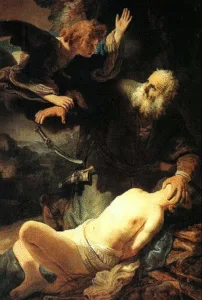 Delilah as angel, bearing a strange likeness to the heavenly intercessor in Rembrandt’s akeidah, his binding of Isaac, announces the end of Samson’s self-promoted candidacy as deliverer. This too is a moment of divine presence.
Samson, according to the ancient rabbis, is not the only one laboring under messianic delusions. In the midrash – storytelling as commentary – the patriarch Jacob, sees
Samson’s anointment at birth as nazir (one consecrated to God, through abstaining from wine, leaving his hair uncut), as prelude to his messianic role.
But Jacob should have known better: though Samson’s unnamed mother is from the tribe of Judah (from which the messiah is destined to come), his hapless father Manoah is from the tribe of Dan. No matter Samson’s self-delusions, and Jacob’s assent to them, Samson has the wrong tribe on his resume.
The patriarch envisions the theater, the Temple of Dagon, in which Samson is forced to ‘play,’ like a carnival clown for the jeering Philistines. The hero grabs hold of the two massive pillars, bringing the Temple down on himself and Philistines. Caught in an avalanche of stone, Samson lies dead among the Philistines, the covenantal promise he was meant to embody buried with him in the rubble.
With the epiphany of his misplaced faith, the patriarch halts and cries out:
‘For Your salvation, God, I hope.’ Li’shu’aticha, kiviti…
Samson’s end is final, his own, yet Jacob continues to hope – the Hebrew word kiviti holds past and future together, both ‘I have hoped’ and ‘I continue to hope.’ The King James translators, sensitive to the ambiguity of tenses, choose ‘wait,’ stressing the continuity between past, present, and future. However impossible salvation may appear, Jacob refuses to stop hoping.
The sound that a clock makes: tick-tock, the beginning and end that gives the shape to cosmic history: the ‘tick’ of Genesis’s ‘In the beginning,’ and the ‘tock’ of the messianic age. Samson mistakenly thinks that he has come, as deliverer, to announce the ‘tock.’ But it turns out he is just part of the story. But Jacob’s hope remains, his faith in what Shakespeare’s Lear calls the ‘promised end,’ ever distant, yet ever present. Jacob wants mashiach now, but he must wait. Hope sustains the end through the seemingly interminable interval, the time between the tick and the tock.
For Jacob everything depends on hope – ha-kol b’kivui. The death of Jewish martyrs is included in hope; generations of suffering as well. Death means something; our suffering is not for nothing. We do not claim to understand, but in the hope for the future we make the present – the interval between the tick and the tock – bearable.
Without hope the past is only a place of nostalgia, creating an empty present, leading into a future of meaningless repetition: ‘tomorrow, and tomorrow, and tomorrow.’ But Jacob’s hope tends toward a promised future, the tock, however delayed, that reaches backward to give meaning and direction to the present, even when the present feels hopeless.
Hope, then, is not the all-too-easy affirmation, as it is for bad politicians and religious readers, their cynicism masquerading as certainty, that we have reached the end. Not the role Samson wanted, but his story is a warning against the premature assertion that we have already arrived. Jacob’s hope is not a political stance, but an orientation. Even when hopeless, when redemption is delayed, he hopes.
In his vision, Jacob sees Samson’s body, lost under the ruins and corpses, his family despairing of giving him a proper burial. So Jacob prays, a kindness, that propels history forward. Samson is buried in the tomb of his father Manoah; Jewish history continues. Jacob’s prayer is a mourner’s kaddish for Samson, a protest of hope in the face of nihilism.
The messiah is dead. Long live the messiah.
The Jewish optimism of hopelessness – kiviti – the hope that remains after all hope is lost.
Tick…